TABLE OF CONTENTS
- Summary
- State by State Requirements for a Lessor Ending a Tenancy
- Updating @realty Cloud After a Vacate Notice is Received or Sent
Summary
A property owner and lessor has the ability to end a tenancy. However they would need to ensure they end the tenancy on the grounds outlined under the relevant state legislation that applies to residential tenancies.
Typically a tenancy can be ended by a landlord under specific grounds and if a fixed term agreement is in place the ending of an agreement cannot end before the expiry date of the current fixed term agreement, unless the tenant has breached the terms of their agreement.
It is important for an agent to ensure that they have written authority and instruction from a property owner to end the tenancy. A phone conversation is not sufficient in this instance. If the property owner refuted an alleged instruction to end the tenancy and suffers financial loss they could have the ability to make a claim against the agency for this financial loss.
It’s important to ensure that the terms noted on an Notice to Vacate that is issued to a tenant match what grounds your state tenancy legislation allows you to end the tenancy
e.g. in Queensland if an owner wants the tenants to vacate at the end of a fixed term the grounds would be noted as “end of a fixed term”.
Similarly, in Queensland If the tenant has been issued a Notice to Remedy Breach for rent arrears and does not remedy their breach and a Notice to Leave is issued the grounds of this notice would be “failure to remedy a breach”.
State by State Requirements for a Lessor Ending a Tenancy
Queensland
Ending a Fixed Term Tenancy
A tenancy agreement is a legally binding contract that can only end in certain ways:
by you giving the tenant a Notice to Leave (Form 12) 2 months notice. The Form 12 notice document lists the grounds on which the notice can be issued.
by the tenant giving you a Notice of Intention to Leave (Form 13) minimum 14 days prior to end date of fixed term
break lease Agreement to End Fixed Term Lease
by mutual agreement
by applying to QCAT for an order terminating the agreement with approved grounds, such as excessive hardship or repeated breaches by you or the tenant
Ending a Periodic Tenancy
A periodic tenancy has no fixed end date which means that the tenant or landlord can give notice at any time. The notices and periods are:
- by you giving the tenant a Notice to Leave (Form 12) The ground on which the notice is given must be stated & the specified notice period must be followed
- by the tenant giving you a Notice of Intention to Leave (Form 13) minimum 14 days prior to end date of fixed term
New South Wales
Ending a Fixed Term Tenancy
A residential tenancy agreement is a legally binding contract that can only end in certain ways:
By giving the tenant a Termination Notice: You must provide a written termination notice signed by you or your agent. The notice period depends on the specific ground used:
Breach of Agreement: 14 days notice.
Sale of Premises: 30 days notice (if the contract for sale requires vacant possession).
Proposed Sale, Renovations, or Demolition: 90 days notice (or 60 days for short fixed terms of 6 months or less).
Landlord/Family to Reside: 90 days notice (or 60 days for short fixed terms).
By the tenant giving you a Termination Notice:
End of Fixed Term: Minimum 14 days notice prior to the end date of the fixed term (the termination date must be on or after the end of the fixed term).
Break Lease:
For fixed term agreements of not more than 3 years, a mandatory break fee applies if the tenant abandons the premises or terminates early.
By mutual agreement: The tenant gives up possession with the landlord's consent , or a termination notice is revoked with the consent of all parties.
By applying to NCAT (NSW Civil and Administrative Tribunal): For a termination order on specific grounds, such as hardship to the landlord , serious damage or injury , or persistent breaches.
Ending a Periodic Tenancy
A periodic tenancy (continuing agreement) applies after the fixed term ends. The notices and periods are:
By you giving the tenant a Termination Notice:
Sale of Premises: 30 days notice (if the contract for sale requires vacant possession).
Proposed Sale, Renovations, Demolition, or Landlord/Family to Reside: 90 days notice.
Breach of Agreement: 14 days notice.
Non-payment of rent/charges: 14 days notice (rent must be unpaid for at least 14 days before giving notice).
By the tenant giving you a Termination Notice:
Minimum 21 days notice.
Victoria
Ending a Fixed Term Tenancy
In Victoria, a residential rental agreement is a legally binding contract that can only be terminated in accordance with the Residential Tenancies Act 1997.
1. Notice to Vacate Given by the Residential Rental Provider
Under new rules effective from 25 November 2025, rental providers are banned from issuing "no-fault" evictions. A provider cannot issue a notice to vacate without a valid reason, even at the end of a fixed-term agreement.
The Notice to vacate to renter of rented premises can be found on the following webpage: https://www.consumer.vic.gov.au/housing/renting/moving-out-giving-notice-and-evictions/notice-to-vacate/notice-to-vacate-in-rental-properties
2. Notice of Intention to Vacate Given by the Renter
End of Fixed Term: The renter must give a minimum of 28 days notice of their intention to vacate. The termination date must be on or after the end date of the initial fixed term.
Early Termination (Break Lease): If a renter terminates before the end of the fixed term, the Tribunal (VCAT) determines compensation based on actual costs (advertising and reletting fees) and lost rent, but these must be proportionate to the remaining term. Providers must take reasonable steps to mitigate loss by promptly reletting the property.
3. Mutual Agreement
An agreement can be terminated at any time if the rental provider and renter both agree in writing.
4. Application to VCAT (Victorian Civil and Administrative Tribunal)
Either party may apply to VCAT for a termination order in specific circumstances, such as:
Hardship: If a party would suffer severe hardship if the agreement were not terminated (VCAT may award compensation to the other party).
Successive Breaches: If a party has breached the same duty provision three times.
Ending a Periodic Tenancy
When a fixed-term agreement ends and no new agreement is signed, it automatically becomes a periodic (month-by-month) lease.
1. Notice Given by the Residential Rental Provider
The provider still requires a valid reason (as listed above) to end a periodic tenancy.
Standard Reasons (Sale, Renovation, Provider Moving In): 90 days notice.
Breach of Agreement: 14 days notice.
Non-payment of Rent: 14 days notice.
2. Notice Given by the Renter
Notice Period: The renter must give a minimum of 28 days notice to end a periodic tenancy.
Western Australia
Ending a Fixed Term Tenancy
A residential tenancy agreement is a legally binding contract that can only end in specific ways defined by the Residential Tenancies Act 1987.
Notice Requirements:
Lessor (Landlord): You must give the tenant a written notice of termination (Form 1B) not later than 30 days before the possession day (expiry date).
Tenant: The tenant must give you a written notice of termination (Form 22) not later than 30 days before the possession day (expiry date).
Note: If the possession day is later than the expiry day, the agreement continues until the possession day.
Other Methods:
Mutual Agreement: By written agreement between the lessor and the tenant to terminate.
Court Order: By applying to the Magistrates Court (competent court) for an order terminating the agreement on approved grounds, such as undue hardship.
Family Violence: A tenant may terminate their interest in the lease with 7 days' notice if they or a dependant are subjected to family violence, provided they supply the required evidence (e.g., DVO, Consumer Protection report).
Ending a Periodic Tenancy
A periodic tenancy has no fixed end date.
The notices and periods are:
Lessor (No Grounds): You must give the tenant a Notice of Termination (Form 1B) with 60 days' notice.
Lessor (Sale of Property): If the property is sold and the contract requires vacant possession, you must give the tenant a Notice of Termination (Form 1C) with 30 days' notice.
Tenant: The tenant must give you a Notice of Termination (Form 22) with 21 days' notice.
Australian Capital Territory
Ending a Fixed Term Tenancy
In Australian Capital Territory, a fixed term tenancy agreement cannot be terminated without grounds. End of a fixed term agreement is not sufficient grounds to issue a notice to vacate.
A tenancy agreement is a legally binding contract that can only be terminated in certain ways by issuing a Notice to Vacate (notice periods apply):
mutually agreed upon between tenant & lessor
the tenant has breached the terms of the tenancy agreement, for example by not paying rent
the ACAT makes an order allowing them to end the tenancy, for example because of hardship
the landlord uses the posting termination clause, if the posting clause is included in the tenancy agreement.
The tenancy can also be terminated if:
the tenant provides Notice of Intention to Vacate by breaking their lease or having a reason under legislation for ending the tenancy
Ending a Periodic Tenancy
A periodic tenancy can only be terminated in certain ways, in addition to the above, by issuing a Notice to Vacate (different notice periods apply):
the landlord intends to sell the property
the landlord intends to rebuild, renovate or make major repairs to the property
the landlord requires the premises for a lawful use other than as a home
the landlord intends to live in the property
someone with a close relationship with the landlord, such as an immediate family member, intends to live in the property.
The tenancy can also be terminated if:
the tenant provides a Notice of Intention to Vacate for reasons specified under legislation
South Australia
Ending a Fixed Term Tenancy
The tenant or the landlord must tell the other person if the lease agreement is ending and not being renewed, at least 60 days before the end date. A prescribed ground must be stated in the notice. If no one gives notice, the agreement continues as a periodic lease. The form a landlord would use is a ‘Form 9 Notice of Termination by Landlord at the End of Fixed Term Tenancy’.
If the tenant moves out before the end of the agreement, they may need to pay re-letting costs, loss of rent and pro-rata advertising costs. The landlord must try to relet the premises quickly to keep these costs as low as possible.
Once a landlord gives a termination notice for a fixed term tenancy, a tenant can give 7 days written notice to move out before the end of the fixed term.
The landlord can end a fixed term agreement early if:
the tenant agrees
the tenant breaks a condition of the agreement such as unpaid rent.
There are many grounds on which an agreement can be terminated. Please review the Form 8 & Form 9 for further information.
Ending a Periodic Tenancy
The tenant needs to give at least 21 days written notice or one month's written notice if rent is paid monthly. The landlord may accept less than the 21 days’ notice but it’s recommended that this be in writing.
A landlord must have a prescribed ground to terminate a periodic tenancy. A Form 8 Notice of termination or periodic tenancy by landlord on specified ground must be issued.
The grounds on which a landlord can terminate a period tenancy agreement are specified in the Form 8 Notice.
Tasmania
Ending a Fixed Term Tenancy
A fixed term tenancy agreement in Tasmania can be ended by the lessor or tenant for the end of a fixed term agreement with minimum 42 days written notice (for the agent). If the tenant leaves after the end of the lease, but before 42 days after the notice was given, they are only required to pay rent until the date they leave.
When you end a tenancy agreement, you must comply with the appropriate notice period & the correct documentation must be completed & provided.
The lessor can end a tenancy during the fixed term (in accordance with notice periods) when:
The agreement has not yet expired & a termination notice is given for end of a fixed term
The tenant has breached the lease. (But if the tenant then stops the issue that was breaching the lease before 14 days has passed, the notice has no effect)
the tenant has caused a ‘substantial nuisance’.
Ending a Periodic Tenancy
A periodic tenancy can only be terminated in certain ways, in addition to the above, by issuing a Notice to Vacate (different notice periods apply):
if the property has been sold, is to be renovated, rented to a family member or used for a purpose other than rental. (42 days notice). If the property has been sold, the notice must be served with proof of an agreement to sell the property for example, a de-identified contract for sale
if the property is sold by a lending institution (eg a bank) to recover money owed by the owner. This notice must provide at least 60 days’ prior to the date the tenant is to leave.
the tenant has failed to comply with a condition of the lease. (no effect if breach rectified within 14 days)
the tenant has caused a ‘substantial nuisance’.
The tenancy can also be terminated if:
the tenant provides termination notice for reasons specified under legislation
Updating @realty Cloud After a Vacate Notice is Received/ Sent
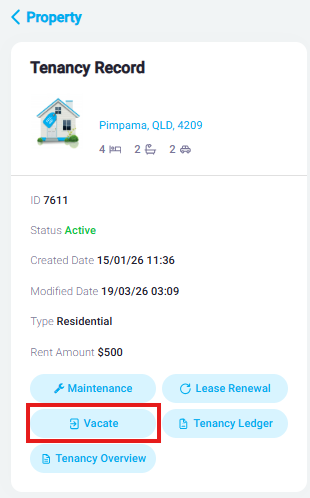
Once you receive or issue a vacate notice, you will need to advise HO Rentals Team so rent is not receipted past the intended vacate date. To do so, please follow the steps below:
1. Go to the Tenancy Record in the Cloud & click the 'Vacate' button on the left hand side of the page:
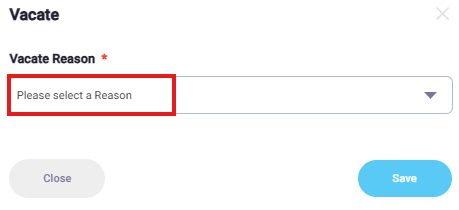
2. Select a Vacate Reason in the box pictured below (the options are End of Tenancy, Termination or Break Lease):
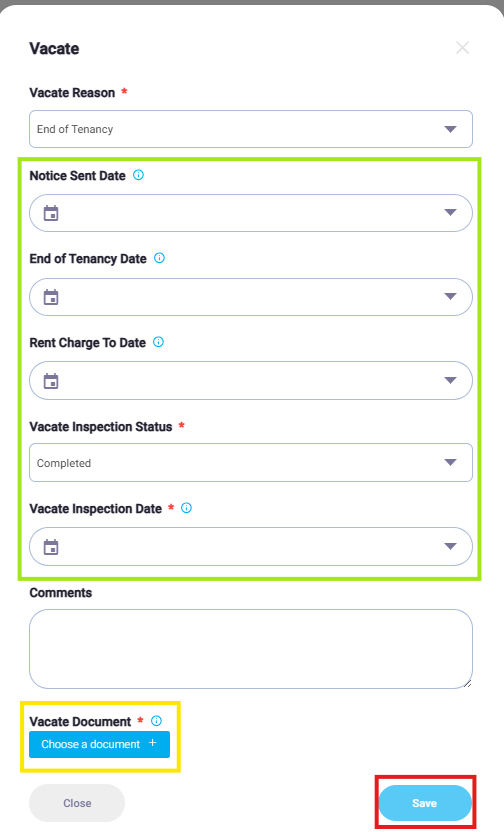
3. Enter all of the information in the green box pictured below.
Upload the vacate notice into the 'Choose a Document' yellow box pictured below.
Once all information is entered, click 'Save'
4. Once the vacate information is updated, HO Rentals will be notified & will update Property Tree accordingly. You will receive an email with vacate information & a link to a Bond Refund checklist to complete once all charges are finalised for the tenancy.
A link to the Vacate & Bond Refund checklist can be found below:
https://form-flow.app/forms/vacate-bond-refund-checklist-3055
5. Once Head Office Rentals receives the Vacate & Bond Refund checklist form, we will initiate the bond refund through the relevant bond authority.
Was this article helpful?
That’s Great!
Thank you for your feedback
Sorry! We couldn't be helpful
Thank you for your feedback
Feedback sent
We appreciate your effort and will try to fix the article