TABLE OF CONTENTS
- Why are routines important?
- Routine inspection timeframes
- Routine inspection notices
- How to schedule & manage routines
Why are routines important?
Routine inspections are a crucial aspect of property management for several reasons:
Maintenance and Repairs
Identify Issues Early: Regular inspections allow you to catch problems before they escalate, saving you time and money in the long run. When inspecting the property, you should be briefly testing property inclusions such as appliances, lights, taps, cooling & heating systems.
Plan for Upgrades: They give you the opportunity to plan for necessary upgrades or routine maintenance.
Tenant Compliance
Lease Agreement: Inspections ensure that tenants are complying with the lease terms. (e.g. maintaining gardens & lawns, unapproved occupants living at property, unapproved pet being kept at the property)
Safety Standards: They make sure the property is being kept to the necessary safety and health standards. (e.g. tenants removing smoke alarms, storing materials in the property that may be a potential fire hazard)
Property Value
Maintaining Quality: Inspections help maintain the property's overall quality, which is crucial for preserving its market value. This includes making sure the tenant is meeting their obligations & ensuring the property remains in a reasonable state of repair.
Legal Protection
Documentation: In case of legal disputes, having a record of regular inspections can serve as evidence to protect your interests. Regular inspections can also provide a timeline of events which may be extremely useful in disputes.
To fulfill your duties as the managing agent of a property, you need to ensure the property is inspected regularly.
Tenant Relationship
Communication: Conducting routine inspections provides an opportunity for property managers to interact with tenants, strengthening the landlord-tenant relationship.
Financial Planning
Budgeting: Knowing in advance what repairs are needed allows for better financial planning and budgeting.
Insurance
Policy Requirements: Some insurance policies may require regular inspections to remain valid.
Regular inspections are a win-win for both the property owner and the tenant, as they ensure the property is well-maintained and any issues are dealt with promptly.
Routine inspection timeframes
Routine inspections in Australia can differ by state and territory, as real estate and tenancy laws are not federally regulated but are overseen by each jurisdiction. Here are the general guidelines for the recommended time frames for routine inspections in various Australian states and territories:
New South Wales (NSW)
First Inspection: Can occur within the first 3 months of the lease.
Subsequent Inspections: Up to 4 times per year.
Victoria (VIC)
First Inspection: Cannot occur within the first 3 months of the lease.
General Rule: Not more than once every 6 months.
Queensland (QLD)
First Inspection: Can occur after the first 3 months.
Subsequent Inspections: No more than once every 3 months.
South Australia (SA)
General Rule: No more than once every 4 weeks.
Western Australia (WA)
First Inspection: Can occur within the first 6 weeks.
Subsequent Inspections: Not more than once every 3 months.
Tasmania (TAS)
First Inspection: Can occur within the first month of the lease.
Subsequent Inspections: No more than once every 3 months.
Australian Capital Territory (ACT)
General Rule: Not more than twice within any period of 12 months.
Northern Territory (NT)
First Inspection: Can occur within the first 3 months.
Subsequent Inspections: No more than once every 3 months.
Please note that these are general guidelines and may be subject to change. It's crucial to check the most up-to-date legislation or guidelines for your specific jurisdiction.
Routine inspection notices
The notice requirements for routine inspections can vary by state and territory in Australia, as each has its own legislation governing residential tenancies. Here are the general rules:
New South Wales (NSW)
Notice Required: At least 7 days written notice.
Victoria (VIC)
Notice Required: At least 7 days notice. The notice must be in writing and specify the reason for entry & the day of entry, which must be between 8 am and 6 pm.
Queensland (QLD)
Notice Required: Entry notice (Form 9) must be given at least 7 days before the inspection. You must specify a date & either a time of entry or a two hour period.
South Australia (SA)
Notice Required: At least 7 to 28 days written notice. The notice must state a period of up to 2 hours that the proposed entry will occur unless in a remote location.
Western Australia (WA)
Notice Required: Typically, between 7 to 14 days notice is required. The notice must be in writing. Entry can only occur between 8am - 6pm on a weekday & 9am - 5pm on a Saturday.
Tasmania (TAS)
Notice Required: At least 24 hours notice. The notice must specify the reason for entry and propose two reasonable times of entry between 8 am and 6 pm.
Australian Capital Territory (ACT)
Notice Required: At least 7 days written notice. The notice must specify the day and time range (of up to 2 hours) for the inspection.
Northern Territory (NT)
Notice Required: At least 7 days notice. The notice must specify the date and time of the inspection.
Please note that these are general guidelines, and the specifics can vary, including exceptions or additional requirements like the mode of delivering the notice (e.g., email, post, hand delivery). It's essential to consult the most current regulations for each jurisdiction to ensure compliance.
How to schedule & manage routines
When creating a tenancy record in the @realty CRM, the first Routine Inspection is automatically added 3 months after the Lease Start Date.

Scheduling an Inspection
To schedule your routine inspection in Inspection Manager, you will need to access the @realty Cloud. You will only be scheduling inspections through the Cloud, not creating them in the Inspection Manager platform.
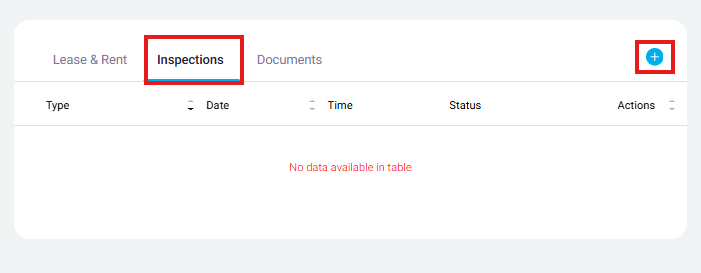
Visit the Tenancy Record > Click 'Inspections' near the middle of the screen > Click the '+' in the top right corner of the box (pictured below)
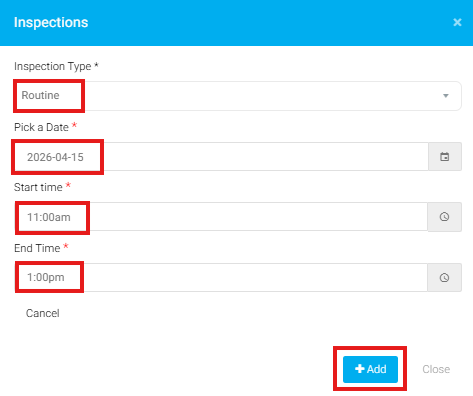
Once it opens the below pop up window, fill in the inspection information > Once complete, click 'Add'
Once added, the inspection will now be visible in the Tenancy Record page. This will take up to 24 hours to become visible in your Inspection Manager. If you need to access the inspection sooner, please contact Head Office Rentals team via email or phone call.
Using Inspection Manager to do the Routine Inspection
When you are ready to inspect the property you will need to use the Inspection Manager tool. To learn how to conduct the inspection using Inspection Manager, click HERE and HERE.
If you have not used Inspection Manager before, you can learn about the platform here.
Also, it is recommended that you create a dummy routine inspection time so you can familiarise yourself with the tool, but do not send the report to your landlord.
Once you have completed the Routine Inspection in Inspection Manager
When you close the routine inspection in Inspection Manager, you can send it to the owner directly through Inspection Manager for their review. You can add any specific comments for the landlord.
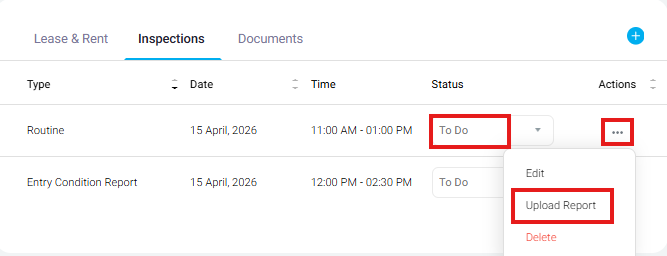
Download the completed routine report once complete > Go to the Tenancy Record in the Cloud > Inspections tab > Click the three dots & click 'Upload Report' to save the PDF report to the Tenancy Record.
To mark it as completed, click the Status box & change it to 'Completed'.
Was this article helpful?
That’s Great!
Thank you for your feedback
Sorry! We couldn't be helpful
Thank you for your feedback
Feedback sent
We appreciate your effort and will try to fix the article