TABLE OF CONTENTS
- Smoke Alarm Compliance managed by Agent
- Smoke Alarm Compliance managed by HO Rentals
- Smoke Alarm Requirements for Rental Properties by State
Smoke alarms in rental properties must be maintained, functional at all times & compliant with requirements as per legislation.
The smoke alarms should be checked for compliance by a licensed contractor. It's always recommend to use a reputable Smoke Alarm technician company. Many Smoke Alarm companies offer annual subscription packages that include annual compliance checks - these subscriptions should be recommend to your landlords.
PLEASE NOTE: The below information is subject to change. You should always seek current & relevant information as per legislation in your state.
Smoke Alarm Compliance managed by Agent
When creating the management record, you will tick the below box acknowledging that you will be arranging the smoke alarm compliance as per legislative requirements.
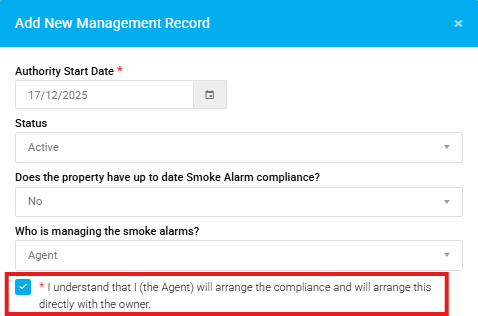
If you are managing the smoke alarm compliance for your rental properties yourself, please follow the steps in the following article to request a work order to be issued:
Smoke Alarm Compliance managed by HO Rentals
When creating the management record, you will tick the below box acknowledging that Head Office will be arranging the smoke alarm compliance as per legislative requirements.
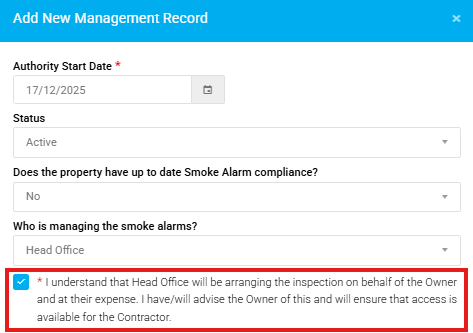
After saving your management record with the management agreement attached, HO Rentals will request your permission to engage a Smoke Alarm company via email.
Once your instructions are provided, Head Office will arrange a Smoke Alarm subscription for the property so annual compliance checks are monitored & scheduled when required.
Smoke Alarm Requirements for Rental Properties by State
Queensland
All rental properties in Queensland that are classed as a ‘domestic dwelling’ under the Fire Services Act 1990 must have interconnected, photoelectric smoke alarms installed.
Smoke alarms in domestic dwellings, caravans and motorhomes must comply with Australian Standard (AS) 3786-2014.
Property managers/owners are required to test smoke alarms within 30 days before the start date of a tenancy, including the start of a renewed tenancy. A Smoke Alarm Compliance certificate must be completed by a qualified third party.
For further information, please refer to the following webpage:
https://www.rta.qld.gov.au/during-a-tenancy/maintenance/smoke-alarms
New South Wales
Landlords must ensure that smoke alarms (including heat alarms) are working. A smoke alarm is not working if it is removed, does not work or is malfunctioning.
Landlords must ensure that at least one smoke alarm is installed in a hallway outside a bedroom or other suitable location in each story of a rented home.
It is recommended to have a compliance certificate completed by a licensed third party to ensure they meet compliance standards.
For further information, please refer to the following webpage:
https://www.nsw.gov.au/housing-and-construction/rules/smoke-alarms-a-rental-property
Victoria
Smoke alarms are compulsory and must be installed in all Victorian residential properties including houses, units, flats and townhouses. Rental providers must ensure their rental property is appropriately fitted with smoke alarms.
All buildings constructed after 1 August 1997 must have hard-wired smoke alarms with a battery back-up. Buildings built before that date can have a battery-powered smoke alarm.
Smoke alarms must meet the Australian Standard AS 3786
Rental providers must ensure that all smoke alarms installed in a rental premises:
- are correctly installed and in working condition
- are fitted with batteries or replacement batteries
- are tested at least once every 12 months in accordance with any instructions by the manufacturer of the smoke alarm.
It is recommended to have a compliance certificate completed by a licensed third party to ensure they meet compliance standards.
For further information, please refer to the following webpage:
Western Australia
Dwellings must have compliant smoke alarms prior to transfer of ownership, rent and hire. The smoke alarms must comply with the edition of the BCA in effect at the time they are installed. They must also be:
- in working order;
- permanently connected to the mains power supply; and
- not more than 10 years old and have not reached their expiry date.
It is recommended to have a compliance certificate completed by a licensed third party to ensure they meet compliance standards.
For further information, please refer to the following webpage:
South Australia
All South Australian homes must be fitted with a working smoke alarm.
Homeowners and residential landlords are responsible for making sure they are working and installed correctly. The type of smoke alarm you need depends on when you bought the property or its age.
For further information, please refer to the following webpage:
https://smokealarmsolutions.com.au/legislation-sa/
Tasmania
The owner must ensure that all alarms installed in rental premises are either permanently connected to the power supply of the premises, or are powered by a 10-year non-replaceable battery.
Smoke alarms permanently connected to the power supply of the rental premises must also have an alternative power supply as a back-up. A smoke alarm containing a replaceable battery does not comply with the Regulations.
The owner must ensure that alarms are installed at specified locations with regard to the class of residential building.
An installed smoke alarm must comply with either of the below Australian Standards:
- AS 3786 – Smoke Alarms Using Scattered Light, Transmitted Light or Ionization; or
- AS 1670.1 – Fire Detection, Warning, Control and Intercom Systems– System Design, Installation and Commissioning – Part 1: Fire.
This means that ionisation or photoelectric smoke alarms may be installed.
Smoke alarms with removable 9 volt batteries do not comply with the standards and cannot be installed.
It is recommended to have a compliance certificate completed by a licensed third party to ensure they meet compliance standards.
For further information, please refer to the following webpage:
https://www.cbos.tas.gov.au/topics/housing/renting/beginning-tenancy/smoke-alarms
Australian Capital Territory
Australian Capital Territory (ACT) law mandates photoelectric smoke alarms.
All smoke alarms must carry up to date certification showing compliance with AS 3786:2014.
You must have a compliance certificate completed by a licensed third party to ensure the smoke alarms meet compliance standards.
For further information, please refer to the following webpage:
Was this article helpful?
That’s Great!
Thank you for your feedback
Sorry! We couldn't be helpful
Thank you for your feedback
Feedback sent
We appreciate your effort and will try to fix the article