Tenants/residents and property managers/owners should work together to ensure that pools in rental properties are safe, compliant and well maintained.
Property owners must ensure their property is not in breach of any health and safety laws, including pool safety laws.
Tenants/residents have a duty to keep pool areas secure, report issues to their property manager/owner in a timely manner and follow any agreed special terms in their tenancy agreement.
Pool Safety Certificate
Pool owners must have a pool safety certificate issued by a licensed pool safety inspector in most states. A copy of the certificate should be included with the tenancy agreement.
To obtain a pool safety certificate, property owners must meet strict requirements to reduce the risk of children getting into the pool area unsupervised.
If a certificate has not been obtained, a tenant may consider it a breach of the property owner’s duty to comply with all health and safety laws.
PLEASE NOTE: The below information is subject to change. Please refer to relevant legislation and guidelines in your state.
Queensland
Pool safety requirements are outlined in the Queensland Building and Construction Commission’s (QBCC) swimming pool safety standard and cover things such as fence height and strength, gates and latches, and signage.
The Entry condition report (Form 1a) includes a check box for tenants to confirm they have received a copy of the pool safety certificate. The form should also be used to note the condition of the pool at the start of the tenancy.
To check if a pool has a current pool safety certificate, you can use the QBCC’s free pool safety register. Property owners can be fined for not registering a pool with the QBCC.
New South Wales
If a rental property has a swimming pool, landlords must meet the standards in the Swimming Pools Act 1992. This requires most pools to be surrounded by a fence that separates the pool from the house.
When the tenant is signing the tenancy agreement at the start of a tenancy, the landlord or agent must provide a copy of the valid certificate of compliance or occupation certificate issued in the last 3 years. This does not apply if the property is in a strata or community scheme that has more than 2 lots.
Victoria
There are laws about swimming pool and spa safety in Victoria, including registration, inspection and certification requirements for property owners.
The owner of the property must:
- register the pool with the local council
- have the pool safety barrier inspected every 4 years
- lodge a certificate with the council, confirming compliance of the pool or spa barrier.
The laws apply to swimming pools and spas that can hold 300 mm (30 cm) of water or more. This includes:
permanent pools, above ground pools, indoor pools, hot tubs (spas) bathing or wading pools, and some relocatable pools.
Western Australia
The pool or spa must have appropriate safety barriers according to the building laws enforced by local government and the residential tenancy laws.
The law requires that private swimming pools are secured by isolation fencing and have correct locking mechanisms on gates.
Under the Building Regulations, a private swimming pool is one that is associated with a dwelling and which has the capacity to contain water that is more than 300 mm deep. This can include spa-pools such as jacuzzis and outdoor hot tubs.
While you and your tenants are both responsible for ensuring that any fence or barrier restricting access to a private swimming pool is maintained and operating effectively, it is ultimately your responsibility to ensure barriers are adequate for any pools/spas provided with the rental premises.
Tasmania
All pools (that can be filled deeper than 30cm) must be protected by barriers which meet the Australian Standards.
South Australia
There are numerous requirements for pool safety in South Australia, please refer to the following webpage for further information: https://www.sa.gov.au/topics/housing/keeping-your-property-safe/pool-and-spa-safety
Australian Capital Territory
A pool safety certificate should be completed by a licensed provider to ensure that required standards are met. Please refer to relevant state legislation for further information.
Managing Pool Compliance in the Cloud
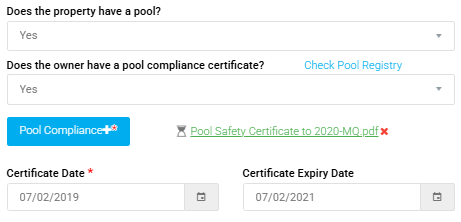
In each management record, there are sections regarding pool compliance. It also requires the user to upload the certificate if it is marked 'Yes' as having a certificate.
The user should then enter the certificate date & the expiry, as pictured below:
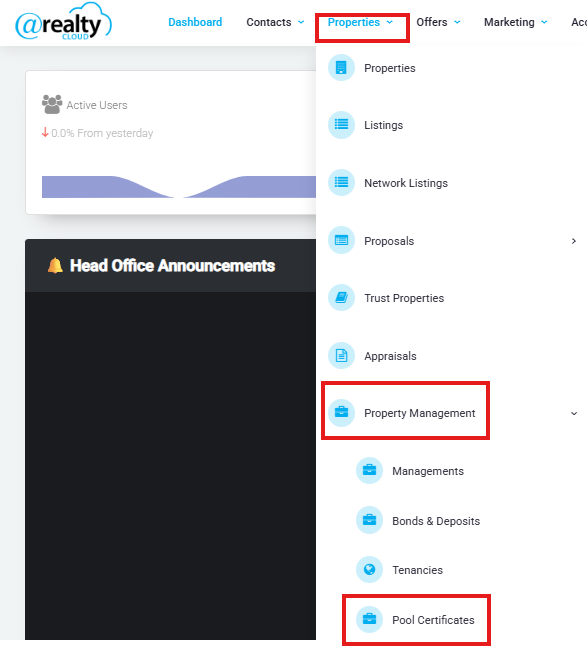
Once pool compliance information is entered into the Management Record, you can access a list of your Pool Compliance certificates through the Cloud. Please see below steps:
Was this article helpful?
That’s Great!
Thank you for your feedback
Sorry! We couldn't be helpful
Thank you for your feedback
Feedback sent
We appreciate your effort and will try to fix the article