TABLE OF CONTENTS
- General Information
- Best Practice Procedure
- Hints & Tips on completing a Tenancy Agreement
- State by State Requirements & Restrictions on 'Lease Renewals'
- Uploading a lease renewal agreement to the CRM
General Information
The term Lease Renewal is one that is used so often that people think this is what actually happens when a tenant is offered a new fixed term tenancy for a further term.
The truth is you aren't actually "renewing" the previous tenancy, you are offering a new fixed term tenancy for a further term. Terms typically change, even in a minor way, between tenancies. This could be a change in a housemate, a household pet, a rent increase, whether or not the tenant pays for a utility / service etc.
Each state has notice periods for where you (or the Landlord) may want to increase the rent when offering a new tenancy. This is something you should be mindful of and check with your relevant State Tenancy Authority.
Best Practice Procedure
Not only should you be mindful of what the minimum notice periods are, you should also adopt a best practice procedure that allow for enough time for negotiations between landlord and tenant (where needed).
Below we are going to use the Queensland Tenancy timeframes as an example of how you could set up a process within your business to factor in the minimum time frames needed as well as what to do from a best practice standpoint.
- Run a report of expiring leases in 3 months time (3 months before the end of a lease is when this process should start for a QLD property manager)
- Assess whether or not rent can actually be increased for the properties you are reviewing (in QLD you are now only allowed to increase rent once every 12 months regardless of how many tenancies have occurred in the last 12 months)
- Assess the market and work out whether there is an opportunity to increase the rent (conduct a market analysis and review where needed)
- Contact your Landlord and seek their instructions to offer a new tenancy or not. Provide a reasonable timeframe and deadline for them to respond, advising that if you don't hear from them by that deadline you will offer a new tenancy in their best interest and to avoid the property becoming vacant and non-income generating for them
- The information you provide your Landlord should include advice on their options should the tenant not wish to take up the offer of a new tenancy. In Queensland ultimately there are two options. One is to let the tenancy revert to a periodic tenancy. This is not recommended as it creates uncertainty with the tenants being able to give 2 weeks notice to vacate the property at anytime in the future. The other option is to end the tenancy and search for a new tenant that would be eager to enter into a fixed term tenancy. If this is the option you need to be very mindful of the minimum notice period in place to end a tenancy (in Queensland it is 2 calendar months but cannot expire / end before the end date of the current fixed term tenancy).
- The deadline for the Landlord to get back to you should not be any later than 2.5 months prior to the tenants lease end date
- Once you have approval to offer a new tenancy, offer this to the tenant with a 7 day timeframe to return the tenancy signed. In that offer ensure you advise them of any rent increase and/or change of tenancy terms. Also ensure that you make them aware that should they not accept the offer within the timeframe noted that the offer will be considered as withdrawn and further instructions will be sought from the Landlord. Those instructions may result in the Landlord requesting the tenancy to be ended and Notice to be given to the tenants.
- If the offer of a new tenancy is signed and returned by the tenants:
- Ensure your Landlord receives a copy of the signed agreement
- Ensure that any rent increase that is due to take place is entered into your Trust Accounting Software
- Ensure any increase / top up in bond is also noted in your Trust Accounting Software
- If relevant, ensure that your Smoke Alarm Contractor is booked to test and check the smoke alarms prior to the commencement of the new fixed term tenancy
- If applicable, ensure any fees that can be charged (in accordance with your Appointment) are processed through your Trust Accounting Software
Hints & Tips on completing a Tenancy Agreement
- Lease start and end dates should line up with the rent cycle of the tenancy
- Weekly Rent Tenancies
- If the rent agreed on is a weekly rent with the 12 month tenancy commencing on Friday 20 September 2024, you should have the lease expiring on Thursday 18 September 2025.
- This allows for you to increase the rent on the offer of a new tenancy from Friday 20 September 2025 which is the same day of the week the normal rent is due
- It also makes it nice and easy to explain to the tenant how much rent they owe in the lead up to them vacating (if they end the tenancy) as the tenancy is a very clean number of weeks (not weeks and a pro-rata of days on top of that)
- Monthly Tenancies
- If the rent agreed on is a monthly rent with the 12 month tenancy commencing on Friday 20 September 2024, you should have the lease expiring on Friday 19 September 2025.
- This allows for you to increase the rent on the offer of a new tenancy from Friday 20 September 2025 which is the same day of the month the normal rent is due
- It also makes it nice and easy to explain to the tenant how much rent they owe in the lead up to them vacating (if they end the tenancy) as the tenancy is a very clean number of calendar months
- Remember: to calculate a monthly rent you should multiply the weekly rent by 52, then divide that figure by 12. Don't simply multiply the weekly rent by 4 as this will short change your Landlord.
- Everyone over the age of 18 should be added to a tenancy as a tenant, even if its adult children of the tenants living at the property. This allows your more tenants to be responsible for all the term and obligations of the tenancy. It also assists younger people in obtaining future rental properties as a reference can be provided
State by State Requirements & Restrictions on 'Lease Renewals'
Please note, the information shared below may not be current as legislation changes are frequent. Please check your relevant State Legislation for confirmation.
Queensland
How a Fixed Term Tenancy Continues
In Queensland, there are three ways a fixed term tenancy can continue:
1. Extend the existing fixed term agreement by agreeing on a new end date,
2. Enter into a new fixed term agreement (which may include changes to the terms of the agreement), or
3. Do nothing and allow the agreement to convert to a periodic agreement.
Significant Changes to Agreement
If a tenant signs a new fixed term agreement that contains significant changes to the terms and conditions of the original agreement they can dispute it with the RTA.
A significant change may include:
- an excessive rent increase
- the way rent must be paid
- the number of occupants allowed to live in the property
- a change to the special terms, or
- a change to the special terms about keeping pets
The tenant must sign the new agreement first and then has 30 days from the start of the new agreement to apply to the RTA’s dispute resolution service.
If conciliation is unsuccessful, the RTA will issue a Notice of unresolved dispute and the tenant can apply to have the matter heard by QCAT.
The tenant must abide by the new terms of the agreement (e.g. by paying the new increased amount of rent) while they wait for a hearing. You and the tenant will be bound by any QCAT orders.
Increasing the Rent
For rent to be increased, it must be at least 12 months since the last increase.
Rent cannot be increased during a fixed term agreement unless it is stated in the tenancy agreement along with the amount or how it will be worked out. Even if rent increases are allowed, 2 months notice in writing must be given.
Rent may be increased at the end of a fixed term agreement if you and the tenant enter into a new tenancy agreement.
Rent can be increased in a periodic agreement by giving 2 months notice in writing.
You cannot increase the rent because the tenant breaches the agreement.
Bond Top Up due to Rent Increase
If there is a rent increase then the bond should also be increased at the RTA so that the bond is still equal to 4 weeks rent. This requirement would need to be sent with the new lease with instructions to the tenant to transfer the balance of bond to the Rental Trust account before the rent increase takes effect.
Please refer to the following article for further information on bond top ups: https://www.atrealtysupport.com.au/support/solutions/articles/14000149148-residential-bond-top-up
Tenancy Agreement Not Being Renewed
Please refer to Lessor Ending a Tenancy for further information if an agreement is not being renewed: https://www.atrealtysupport.com.au/support/solutions/articles/14000147012-lessor-ending-a-tenancy
New South Wales
Two types of tenancy agreement
1. A fixed-term agreement is for a period of time and has a specific end date (e.g. for 6 or 12 months).
2. A periodic agreement is where a fixed-term has not been specified in an agreement or where the fixed-term of an agreement has expired.
If a fixed-term agreement ends and a new agreement is not signed, a tenant will automatically move to a periodic agreement (also known as a continuing agreement). A periodic or continuing agreement has no specific end date.
How a Fixed Term Tenancy Continues
In New South Wales, there are three ways a fixed term tenancy can continue:
1. Extend the existing fixed term agreement by agreeing on a new end date,
2. Enter into a new fixed term agreement (which may include changes to the terms of the agreement), or
3. Do nothing and allow the agreement to convert to a periodic agreement.
Increasing the Rent
If the fixed term period of the agreement has ended and the tenant is on a continuing (periodic) tenancy you may increase the rent. Rent can be increased during the fixed term of the agreement only in certain circumstances (see below).
Rent increases are limited to once every 12 months for all residential tenancy agreements.
Before any rent increase can take effect, you must give the tenant at least 60 days notice in writing before the date the increase becomes payable.
The notice must:
- specify the proposed new amount of rent (not the amount of the increase)
- specify the date from which the increased rent is payable
- be signed, dated and properly addressed to the tenant.
You can use the Notice of Rent Increase and if the notice is being posted, you must allow an extra 4 working days for delivery.
During the fixed term
During a fixed term agreement of less than 2 years the rent cannot be increased, unless a term has been added to the agreement saying it can. The term in the agreement must spell out the amount of the increase or the exact method of calculating the increase (eg. a dollar amount or %). It cannot be unclear, like 'in line with the market' or 'by the rate of inflation'.
Even where the tenant has agreed to the increase in the agreement, you still have to provide the minimum 60 days written notice before the increase can take effect.
During a fixed term agreement of 2 years or more the rent can be increased at anytime (so long as 60 days notice is given) but cannot be increased more than once in any 12 month period.
It is important to note that the tenant can give 21 days written notice and vacate before the rent increase becomes payable and is not considered to have broken the agreement early.
You cannot avoid having to give 60 days notice by signing a new agreement with the same tenant. The notice still has to be given 60 days before the rent increase can take effect.
Bond Top Up due to Rent Increase
Bond top ups are not permitted in New South Wales.
Please refer to the following article for further information on bond top ups: https://www.atrealtysupport.com.au/support/solutions/articles/14000149148-residential-bond-top-up
Tenancy Agreement Not Being Renewed
PLEASE NOTE: You cannot terminate a tenancy in New South Wales on the ground of end of fixed term agreement. Please refer to the Lessor Ending a Tenancy article for further information: https://www.atrealtysupport.com.au/support/solutions/articles/14000147012-lessor-ending-a-tenancy
Western Australia
Two types of tenancy agreement
Tenancy laws distinguish between two primary types of agreements, each with different rules:
1. Fixed-Term Tenancies: Agreements that run for a specific set period.
2. Periodic Tenancies: Agreements that have no fixed end date and continue on a recurring basis (e.g., month-to-month).
How a Fixed Term Tenancy Continues
In Western Australia, there are three ways a fixed term tenancy can continue:
1. Extend the existing fixed term agreement by agreeing on a new end date,
2. Enter into a new fixed term agreement (which may include changes to the terms of the agreement), or
3. If no action is taken to terminate the agreement on the expiry day, it continues as a periodic tenancy on the same terms.
Increasing the Rent
Rent increases are strictly regulated to ensure fairness and transparency:
The 12-Month Rule: Rent increases are only allowed once every 12 months for both fixed-term and periodic agreements.
- For Fixed-Term agreements renewed after new laws began, this rule applies immediately.
- For Periodic tenancies, the 12-month period applies from the start of the new laws, regardless of when the original agreement was signed.
Notice Requirements: Generally, you must provide at least 60 days’ notice in writing using a Form 10. The notice must include the amount of the increase and the date it takes effect. You are not required to provide 60 days’ written notice for a rent increase if the agreement is being renewed.
Fixed-Term Specifics: Rent can only be increased if the agreement (Part C) stipulates either a specific dollar amount or a clear method of calculation (like CPI or a percentage). Listing "market rent" is not permitted.
Rent Reductions: If amenities are significantly reduced, the rent should be decreased accordingly. Tenants may apply to the Magistrates Court if a reduction is not granted.
Bond Top Up due to Rent Increase
If the rent goes up, the security bond may also be increased, provided the following conditions are met:
- A legal rent increase has occurred with the proper notice.
- The tenant is given at least 60 days’ notice of the bond increase.
- The new agreement has been in place for at least 12 months, or it has been at least 12 months since the last bond increase.
Please refer to the following article for further information on bond top ups: https://www.atrealtysupport.com.au/support/solutions/articles/14000149148-residential-bond-top-up
Tenancy Agreement Not Being Renewed
Please refer to Lessor Ending a Tenancy for further information if an agreement is not being renewed: https://www.atrealtysupport.com.au/support/solutions/articles/14000147012-lessor-ending-a-tenancy
Victoria
Three types of tenancy agreement
In Victoria, there are 3 types of residential rental agreements:
1. Short fixed-term agreements:
Most fixed-term agreements are short-term. They might be for 6 or 12 months, but they can be up to 5 years. Short-term agreements can be written or verbal, but we recommended using written agreements. If a short fixed-term agreement ends, and the tenant stays in the rented premises without signing a further agreement, it will automatically turn into a periodic (month to month) agreement.
2. Long fixed-term agreements:
Long fixed-term agreements are for more than 5 years.
There are some different laws for long-term agreements. These include:
- Bond top ups. Rental providers can ask for additional bond after the renter has been living in the property for 5 years and there is a long-term agreement for another 5 or more years.
- Renters installing fixtures and altering the property. A rental provider and renter can agree on some changes before signing a long-term agreement. If those changes are written into the agreement, the renter does not need to get any other permission from the rental provider before making them.
- Breaking the agreement. Renters who leave early may have to pay one month’s rent for every full year remaining on the agreement up to a maximum of 6 months.
Long-term agreements must be in writing. If not, the renter can end the agreement at any time by giving the rental provider 28 days’ notice. The renter will not have to pay a penalty.
If a long fixed-term agreement ends, and you stay in the rented premises without signing a further agreement, it will automatically turn into a periodic (month to month) agreement. The rules of that periodic agreement will be the standard fixed term agreement of 5 years or less at the time the agreement ends.
3. Periodic (month to month) agreements.
When a fixed-term rental agreement ends and the renter continues to occupy the premises, it automatically becomes a periodic (month-to-month) agreement unless the renter gives notice to leave or both parties agree to start a new fixed-term agreement.
Usually, the renter doesn't sign a new agreement when a fixed-term agreement changes to a month-to-month one. If the rental provider or renter want to enter into a written periodic agreement, they must use the prescribed form: Form 1 - Residential rental agreement.
If the fixed-term agreement was for 5 years or less, the terms and conditions of the original agreement still apply to the new periodic agreement.
If a long fixed-term agreement ends, and it rolls over into a periodic agreement, the rules of that periodic agreement will be the standard fixed term agreement of 5 years or less at the time the lease ends.
How a Fixed Term Tenancy Continues
In Victoria, an agreement converts to a periodic agreement after the fixed term agreement end date. Termination notice cannot be given for the end of a fixed term agreement.
Increasing the Rent
The rental provider is not allowed to increase the rent during a fixed term agreement unless the rental agreement (lease) has an additional clause (term) allowing for an increase. If this is the case, the agreement must also state how the increase will be calculated.
To put the rent up, the rental provider must give the renter (tenant) a Notice of proposed rent increase via the method agreed to in the rental agreement at least 90 days in advance.
For further information regarding rent increases in Victoria, please refer to the following webpage:
Bond Top Up due to Rent Increase
Rental providers (landlords) can only request a bond top up:
- in a long-term rental agreement (an agreement of more than 5 years), or
- when renters make changes to a property which will not be restored by the renter at the end of the tenancy.
In long-term rental agreements, rental providers can ask for extra bond after 5 years, but only if there are 5 years or more left on the agreement.
Rental providers must give 120 days’ written notice.
Please refer to the following article for further information on bond top ups: https://www.atrealtysupport.com.au/support/solutions/articles/14000149148-residential-bond-top-up
Tenancy Agreement Not Being Renewed
PLEASE NOTE: You cannot terminate a tenancy in New South Wales on the ground of end of fixed term agreement. Please refer to the Lessor Ending a Tenancy article for further information: https://www.atrealtysupport.com.au/support/solutions/articles/14000147012-lessor-ending-a-tenancy
Tasmania
Two types of tenancy agreement
Tenancy laws distinguish between two primary types of agreements, each with different rules:
1. Fixed-Term Tenancies: A fixed-term agreement has a set end date (e.g., 12 months), providing security against rent increases or eviction until that date
2. Periodic Tenancies: A periodic (non-fixed term) agreement has no end date, providing flexibility to end the lease with 42 days' notice (tenant)
How a Fixed Term Tenancy Continues
In Tasmania, there are three ways a fixed term tenancy can continue:
1. Extend the existing fixed term agreement by agreeing on a new end date,
2. Enter into a new fixed term agreement (which may include changes to the terms of the agreement), or
3. If no action is taken to terminate the agreement on the expiry day, it converts to a non-fixed period tenancy agreement on the same terms.
Increasing the Rent
There is no prescribed maximum amount or cap for a rent increase set under the Tasmanian Residential Tenancy Act 1997. However, a tenant can apply to the Residential Tenancy Commissioner for an order declaring that an increase in rent is unreasonable.
Fixed-Term Agreements: An owner may only increase rent during a fixed-period residential tenancy agreement if the written agreement specifically allows for an increase.
Notice Period: An increase in rent may only take effect from a day that is more than 60 days after the written notice is given.
Time between Increases: The increase may only take effect from a day that is:
- Not less than 12 months after the residential tenancy agreement commenced, was extended, or renewed; or
- More than 12 months after the last rent increase (if rent was previously increased); or
- More than 12 months after the date of an order made by the Commissioner regarding an unreasonable rent increase.
The notice must be in writing and specify both the amount of the increased rent and the day from which the increase takes effect.
Bond Top Up due to Rent Increase
Bond top ups are not permitted in New South Wales.
Please refer to the following article for further information on bond top ups: https://www.atrealtysupport.com.au/support/solutions/articles/14000149148-residential-bond-top-up
Tenancy Agreement Not Being Renewed
Please refer to the Lessor Ending a Tenancy article for further information: https://www.atrealtysupport.com.au/support/solutions/articles/14000147012-lessor-ending-a-tenancy
South Australia
Two types of tenancy agreement
Tenancy laws distinguish between two primary types of agreements, each with different rules:
1. Fixed-Term Tenancies: Agreements that run for a specific set period.
2. Periodic Tenancies: Agreements that have no fixed end date and continue on a recurring basis (e.g., month-to-month).
How a Fixed Term Tenancy Continues
In South Australia, there are two ways a fixed term tenancy can continue:
- Enter into a new fixed term agreement (which may include changes to the terms of the agreement). Upon the return of the lease renewal ensure that a signed copy is sent to the owner and attach the new fixed term agreement against the property in the @realty Cloud.
- If no action is taken to terminate the agreement on the expiry day, it continues as a periodic tenancy on the same terms.
Increasing the Rent
For rent to be increased, it must be at least 12 months since the last increase or 12 months since the agreement started.
Rent cannot be increased during a fixed term agreement unless it is stated in the tenancy agreement along with the amount or how it will be worked out. Even if rent increases are in the fixed term agreement, 60 days notice in writing must be given.
Rent may be increased at the end of a fixed term agreement if you and the tenant enter into a new tenancy agreement.
Rent can be increased in a periodic agreement by giving 60 days written notice in writing.
Bond Top Up due to Rent Increase
If there is a rent increase & it has been two years since the agreement start date & previous bond top up, then the bond should also be increased so that the bond is still equal to 4 weeks rent.
This requirement would need to be sent with the new lease with instructions to the tenant to transfer the balance of bond to the Rental Trust account before the rent increase takes effect.
Please refer to the following article for further information on bond top ups: https://www.atrealtysupport.com.au/support/solutions/articles/14000149148-residential-bond-top-up
Tenancy Agreement Not Being Renewed
Please refer to the Lessor Ending a Tenancy article for further information: https://www.atrealtysupport.com.au/support/solutions/articles/14000147012-lessor-ending-a-tenancy
Australian Capital Territory
Two types of tenancy agreement
Tenancy laws distinguish between two primary types of agreements, each with different rules:
- A fixed-term tenancy has a fixed period. During the period of the fixed term there are less options for both the tenant and the landlord to end the tenancy agreement.
- A periodic tenancy can continue indefinitely until either the tenant or the landlord ends it.
When a fixed-term tenancy ends, the tenant can stay in the property without signing another agreement. The tenancy simply changes to periodic. Landlords are not allowed to end a tenancy simply because the fixed term has ended. They also cannot force a tenant to sign a new fixed-term tenancy agreement.
How a Fixed Term Tenancy Continues
In Australian Capital Territory, there are two ways a fixed term tenancy can continue. However, entering into a new agreement is optional for the tenant:
- Enter into a new fixed term agreement (which may include changes to the terms of the agreement). Upon the return of the lease renewal ensure that a signed copy is sent to the owner and attach the new fixed term agreement against the property in the @realty Cloud.
- It continues as a periodic tenancy on the same terms after the expiry date of the fixed term agreement.
Increasing the Rent
Rent can only be increased:
- if it’s included as a condition in the agreement, usually by writing that the rent may be increased during the agreement and how it will be worked out – eg according to CPI.
- when the lease is going to be extended, but only if it’s been 12 months since the agreement started, or when the rent was last increased.
Notice Period
Generally, landlords must give tenants at least 8 weeks’ notice of a rent increase.
Rent Increase Cap
Generally, landlords can increase rent by no more than 10 per cent above the growth in the rents component of the Consumer Price Index (CPI) for Canberra. This is known as the prescribed amount.
This is measured from:
- the date the last rent increase notice was given, or
- the start date of the tenancy, if there hasn’t been a rent increase since the tenancy agreement began.
If you are in a consecutive tenancy agreement, the tenancy started on the start date of the first tenancy agreement.
A landlord can increase the rent above the prescribed amount only if either:
- they tell the tenant in writing that the proposed increase is above the prescribed amount, and the tenant agrees to the increase in writing
- they apply for and get an order from the ACT Civil and Administrative Tribunal (ACAT).
Bond Top Up due to Rent Increase
Bond top ups are not permitted in Australian Capital Territory.
Please refer to the following article for further information on bond top ups: https://www.atrealtysupport.com.au/support/solutions/articles/14000149148-residential-bond-top-up
Tenancy Agreement Not Being Renewed
PLEASE NOTE: You cannot terminate a tenancy in New South Wales on the ground of end of fixed term agreement. Please refer to the Lessor Ending a Tenancy article for further information: https://www.atrealtysupport.com.au/support/solutions/articles/14000147012-lessor-ending-a-tenancy
Uploading a lease renewal agreement to the CRM
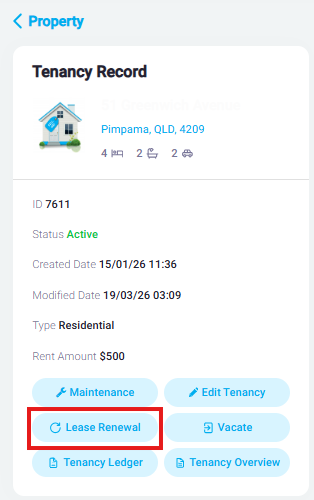
When you have a signed copy of the tenancy agreement you should be uploading this to the @realty CRM in the Tenancy Record so that the HO Support Team can process what is required on the administrative side of things for you.
1) Open the Tenancy Record & click the 'Lease Renewal' button on the left hand side of the screen as shown below:
2) You will fill out the information as per the new agreement & will upload the tenancy agreement. Once completed, click 'Save'
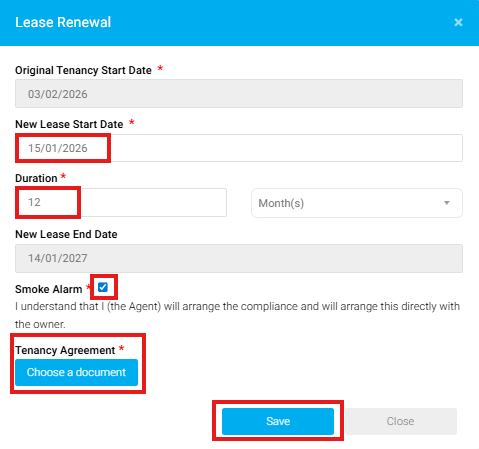
3) This will prompt the HO Rentals Team to review the agreement for compliance. Once compliant, the HO team will update the agreement details in Property Tree.
Was this article helpful?
That’s Great!
Thank you for your feedback
Sorry! We couldn't be helpful
Thank you for your feedback
Feedback sent
We appreciate your effort and will try to fix the article